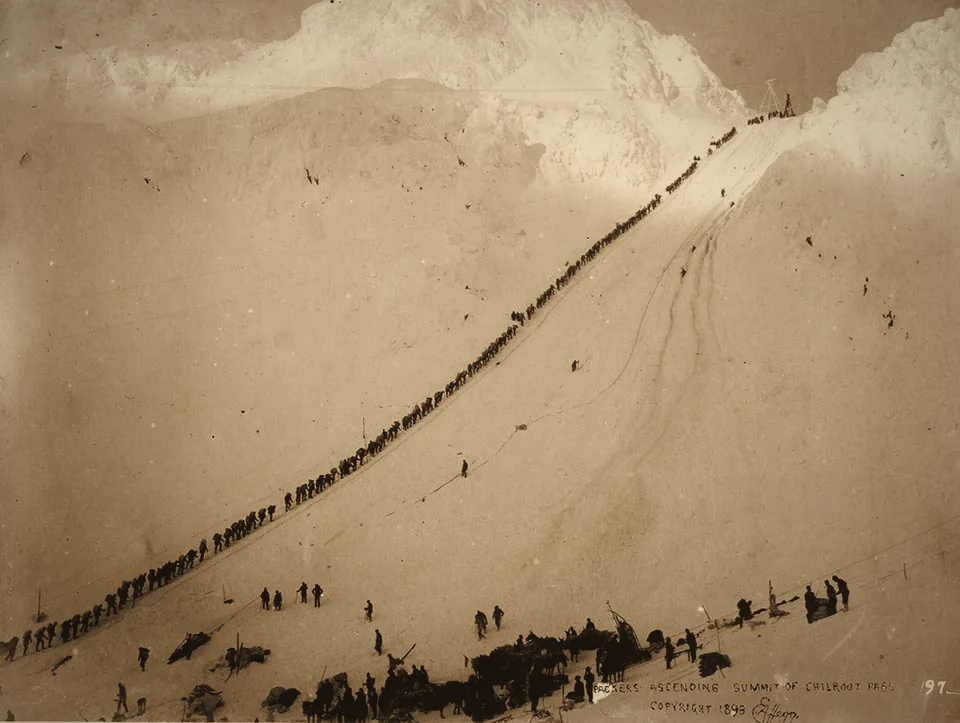
Chilkoot Pass, Alaska, about 1898 · historical photograph, not Triple 8’s claims
Claim owners · Alaska
Selling mining claims in Alaska
Alaska has two kinds of mining claims. Federal claims on BLM-managed land are filed with the BLM and recorded in the state recording district. State claims on state land are held under the Alaska Department of Natural Resources and kept alive by yearly rent and annual labor instead of the BLM fee. Before selling, find out which kind you hold, then confirm every payment and filing for the current year.
Before you sell
What to check for Alaska claims
| Two kinds of claim | Federal claims carry a BLM serial number; state claims carry an ADL number from the Department of Natural Resources. The offices, payments and deadlines are different, so check which kind each claim is first. |
|---|---|
| BLM office | BLM Alaska State Office, with public information centers in Anchorage and Fairbanks. |
| Federal fee | BLM maintenance fee of $200 per lode claim, or per 20 acres of placer, by September 1 each year, or a small miner waiver if you hold 10 or fewer claims. With a waiver, an affidavit of annual labor is filed with the BLM by December 30 and recorded in the recording district. |
| State claims each year | Annual rent paid to the Department of Natural Resources by November 30 for the rental year that began September 1; the rent rises with the claim’s age and is adjusted for inflation (AS 38.05.211). Annual labor of at least $100 per traditional or 40-acre claim, or $400 per 160-acre claim, for each labor year ending at noon on September 1, with a statement of annual labor recorded within 90 days. Cash may be paid in place of labor by September 1. |
| Recording | Alaska has no county recorders. Documents are recorded with the State Recorder’s Office in the recording district where the claim lies. For a new location, the certificate of location is recorded within 90 days of posting the notice (AS 27.10.050); a federal claim also goes to the BLM within 90 days of location. |
| Transfers | Deed recorded in the recording district. For state claims, the deed’s title includes the word “mining” and it lists each claim name, ADL number, section, township, range and meridian, and each party’s mailing address; the department then changes the owner of record (11 AAC 86.155). For federal claims, the recorded deed is filed with the BLM. |
| Permits and reclamation | An Application for Permits for Mining in Alaska (APMA) before placer or hardrock work, with reclamation bonding; many small operators use the state bond pool. Work on federal land beyond notice level also needs a BLM plan of operations. |
| Commonly claimed | Gold, placer and lode, along with silver, copper, zinc and lead. |
Rules and fees change. Confirm them with the BLM, the Department of Natural Resources and the recording district before relying on them.
How a sale of Alaska claims usually works
- Find out whether each claim is federal or state, and check it on the BLM’s or the department’s records. How to check a claim.
- Check the recording district for the location certificate and each year’s labor statement or affidavit.
- For state claims, confirm the rent is paid for the current rental year and that labor, or cash in place of labor, was recorded for the last labor year.
- List any APMA permits and reclamation bonds tied to the ground.
- Agree the structure and terms in writing.
- Every claimant of record signs the deed; it is recorded in the recording district.
- State claims: the department updates the owner of record from the recorded deed. Federal claims: file the recorded deed with the BLM, with a processing fee per claim for each new owner. The BLM does not recognize the buyer until the transfer is filed.
- Agree who pays the next BLM fee, or the next state rent and labor, before the deadline arrives.
Things that trip up Alaska sellers
- Paying the BLM does nothing for a state claim, and paying state rent does nothing for a federal claim.
- Missing the state rent or the labor statement counts as abandonment. It can sometimes be cured by recording the statement and paying a penalty equal to the annual rent, but not if someone else has located the ground in the meantime.
- Part of a state claim cannot be sold until the claim is amended and divided (11 AAC 86.155).
- Land the state has selected but not yet received follows its own rules, and Alaska Native corporation land is private land, not open to claims.
- National parks, wildlife refuges and other conservation units cover much of Alaska’s federal land and are closed to new claims.
Sources: BLM Alaska, 2026 mining claim information guide; Alaska DNR, annual labor fact sheet; Alaska DNR, mining rental worksheet; AS 38.05.211 (annual rental); AS 27.10.050 (recording); 11 AAC 86.155 (transfers of state claims); BLM, 2027 mining claim season fees; 43 CFR part 3833 (recording and transfers). General information, not legal advice.
Own claims in Alaska? Call John Shebanow at 480.253.9748, or send the basics; nothing you send commits you.
Submit your claimsBackground
Alaska’s gold history
In 1897 and 1898, tens of thousands of stampeders landed at Dyea and Skagway and hauled their supplies over the Chilkoot and White passes toward the Klondike gold fields in Canada’s Yukon. Gold discoveries inside Alaska followed at Nome in 1898 and Fairbanks in 1902, and placer and lode mining has continued across the state since.
Deadline reminder
Don’t lose your claims to a missed deadline
The BLM maintenance fee, or a small miner waiver, is due by September 1 every year. Miss it and unpatented claims are forfeited. Leave your email and we’ll remind you about a month before the deadline.
One reminder a year, plus an occasional note when claim rules change. No sales emails. Unsubscribe at any time. See the privacy notice.
Sending…
One moment while your sign-up is sent.
Claims in another state?
Arizona · California · Idaho · Montana · Nevada · Oregon · Utah · Wyoming · All states
Related guides: How to transfer a mining claim · Inherited claims · Claims in an estate